

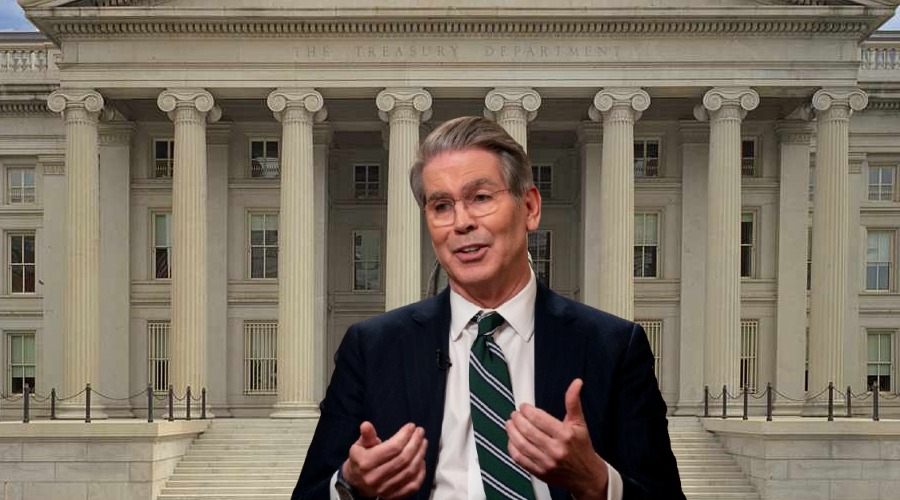
US Treasury Secretary Scott Bessent Urges Congress to Pass CLARITY Act as Senate Debate Stalls
U.S. Treasury Secretary Scott Bessent urged Congress to pass the CLARITY Act, saying the United States needs clear federal rules for digital assets. He said uncertain regulation has made it harder for crypto firms to operate in the country and has pushed more activity to markets with clearer legal standards. His latest appeal comes as lawmakers continue to debate the bill in the Senate after the House approved its version in July 2025.
Bessent said the current framework leaves digital asset companies without enough certainty on registration, compliance, and oversight. He argued that clearer rules would help keep crypto development and investment in the United States. Moreover, he said Congress should act while there is still room on the Senate calendar to move the bill forward.
The U.S. Treasury Secretary is weighing in on the push to pass crypto market structure legislation in a new @WSJ op-ed.@SecScottBessent framed it as a national priority, saying “economic security is national security,” and argued the Clarity Act is the cornerstone to bringing…
— Eleanor Terrett (@EleanorTerrett) April 9, 2026
Bessent urges Senate action on crypto market rules
Bessent repeated his position in an opinion article published on April 8. In that piece, he said Congress must move ahead with market structure legislation because the legal framework for digital assets remains unclear. As a result, firms still face uncertainty when they try to build products and operate in the United States.
He wrote that ”the regulatory framework for digital asset markets is unclear.” He also said that uncertainty has had predictable consequences for the industry. In turn, more crypto development has moved to places such as Abu Dhabi and Singapore, where firms know how to register, what standards they must meet, and how they can operate.
Bessent linked the issue to broader economic policy as well. He said the United States should keep digital asset development and investment anchored at home instead of allowing more of that activity to move abroad. Therefore, his latest remarks added fresh pressure on lawmakers to decide whether the Senate will move the bill in the coming weeks.
CLARITY Act sets framework for digital asset oversight
The Digital Asset Market Clarity Act of 2025 remains the main crypto market structure bill under discussion in Washington. The House passed the measure on July 17, 2025, by a bipartisan vote of 294 to 134. Since then, the bill has remained under Senate consideration.
The legislation aims to create federal rules for digital asset markets after years of calls from the crypto industry for legal certainty. It is designed to provide a clearer structure for how firms register and comply with federal requirements. At the same time, it seeks to define how oversight should work across the sector.
Another major issue is the division of authority between regulators. Market structure legislation has long focused on how oversight should be split across agencies that police securities and commodities activity. Because of that, crypto firms have continued to argue that current law does not clearly fit tokens, trading platforms, and related services.
Stablecoin rewards dispute slows Senate bill progress
Even so, the Senate has not yet moved the bill to final passage. One of the main sticking points is a dispute between banks and crypto firms over how the measure should treat interest and other rewards tied to stablecoin. Consequently, that disagreement has delayed progress for months.
Banking groups have pushed for language that would prohibit or limit those rewards. Crypto firms, however, have argued that the law should provide enough clarity and flexibility for U.S. companies to compete with offshore platforms. Thus, the stablecoin issue has become one of the main unresolved parts of the Senate debate.
Bessent has said the bill would give ”great comfort to the market” during periods of volatility. He has also said there is bipartisan support for advancing the measure, although negotiations are still ongoing.
Disclaimer : Crypto News India does not recommend that any cryptocurrency should be bought, sold, or held by you. Do conduct your own due diligence and consult your financial advisor before making any investment decisions.
