

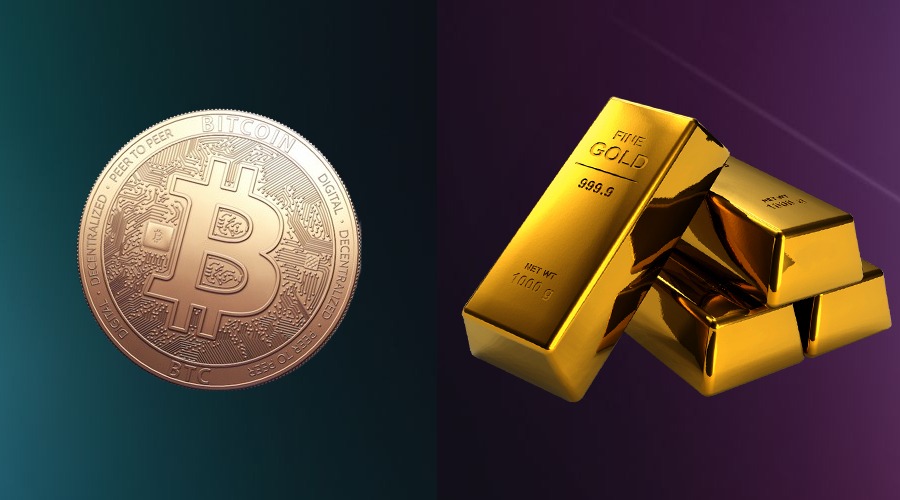
Bitcoin vs Gold in 2026: Gold Trades at $4,328 While Bitcoin Nears $65,000; Which Asset Offers Better Returns, Lower Risk, and Stronger Long-Term Growth Potential?
The Bitcoin vs. Gold debate has intensified over the past few years as both assets react differently to inflation, geopolitical events, and institutional capital flows. Despite gold’s dominance this year, Bitcoin remains appealing to long-term investors who are confident about cryptocurrency’s future.
Gold Performance
The precious metal is trading at $4,328, significantly lower than its all-time high of $5,602.22 per ounce that it touched in January. The traditional safe-haven asset is hot due to strong central bank demand, a weaker US dollar, and geopolitical uncertainty. Gold sits 22.75% below its all-time high.
JPMorgan has predicted that, driven by further central bank diversification of holdings, gold could trade at $6,000 per ounce by 2027.
Gold exchange-traded funds (ETFs) ended their 13-month streak of consecutive inflows in May 2026, recording net outflows of around Rs. 725 crore, a sharp reversal from inflows of about Rs. 3,040 crore in April, according to data from the Association of Mutual Funds in India (AMFI) released on June 10.
“Gold ETF flows slowed to a trickle in May, with Europe the only region to register inflows. Global gold ETF AUM declined 2% m/m to $604 billion, while holdings eased to 4,121t, just shy of February’s record high. Gold market liquidity remained robust, with trading volumes slightly higher m/m and still above the 2025 average. Net outflows pushed global gold ETF total assets under management (AUM) down 2% m/m to $604 billion. Collective holdings ticked lower 0.4% to 4,121t, remaining just below the record high of 4,176t reached on 27 February 2026,” said the World Gold Council.
Goldman Sachs has remained bullish, projecting the price of gold will reach $4,900 by the end of 2026.
Bitcoin Faces Short-Term Challenges
Bitcoin fell close to 50% to the current $65,000 level from its all-time high of $126,000 in October 2025 and has been in a downward trend since early May.
Bitcoin ETFs have seen over $53 billion in net inflows since launch in January 2024, and all Bitcoin ETFs now hold over $100 billion in total assets.
Accompanied by further institutional involvement, analysts at DL News estimate the value of Bitcoin ETF assets will reach $180 billion-$220 billion by the end of 2026.
BlackRock’s Bitcoin ETF continues to be a notable factor driving demand, with $62 billion in total net inflows and contributing to the acceptance of Bitcoin as a mainstream investment option.
Also Read: What Drives Bitcoin Prices? Key Factors Every Investor Should Know
Risk Versus Reward
Volatility is the greatest contrast between the two assets. The annualized volatility of Bitcoin is estimated at 70%-80%, while the volatility of gold is estimated at 15%-20%. This increases the volatility of Bitcoin, but also offers a larger reward.
On an inflation-adjusted return, Bitcoin generated returns of more than 15,016% over the past ten years (2016-2026), while Gold gave a return of 208% from 2016-2026.
Compared to gold, Bitcoin gave massive returns; however, stability is what gold offers and tends to do well in economic slowdowns.
Which Investment Is Good?
Gold is a better option in 2026 as it offers capital protection and reduced volatility. Its investment case remains robust with central bank demand, ETF flows and overall positive macroeconomic trends.
Bitcoin presents a strong long-term investment prospect for those who are looking for higher growth potential and can handle the high volatility, as it benefits from the adoption of Bitcoin Exchange Traded Funds (ETFs), growing institutional interest, and its capped supply of 21 million coins.
FAQs:
1. Why is gold outperforming Bitcoin in 2026?
Gold has benefited from strong central bank purchases, geopolitical uncertainty, and demand for safe-haven assets. These factors have helped gold remain resilient despite recent ETF outflows.
2. How much have Bitcoin and gold returned over the last decade?
Bitcoin has delivered inflation-adjusted returns of more than 15,000% between 2016 and 2026, while gold generated cumulative returns of around 208% during the same period, highlighting the difference in risk and reward.
3. Are Bitcoin ETFs attracting institutional investors?
Yes. Bitcoin ETFs have accumulated more than $53 billion in net inflows since launching in 2024 and now hold over $100 billion in assets, reflecting growing institutional participation.
4. Which asset is less volatile: Bitcoin or gold?
Gold is significantly less volatile, with annualized volatility of roughly 15%-20%, compared to Bitcoin’s 70%-80%. This makes gold a preferred choice for conservative investors.
5. Should investors choose Bitcoin or gold in 2026?
The choice depends on investment goals. Gold is better suited for capital preservation and lower risk, while Bitcoin may appeal to investors seeking higher long-term growth and who can tolerate substantial price swings.
Disclaimer : Crypto News India does not recommend that any cryptocurrency should be bought, sold, or held by you. Do conduct your own due diligence and consult your financial advisor before making any investment decisions.
