

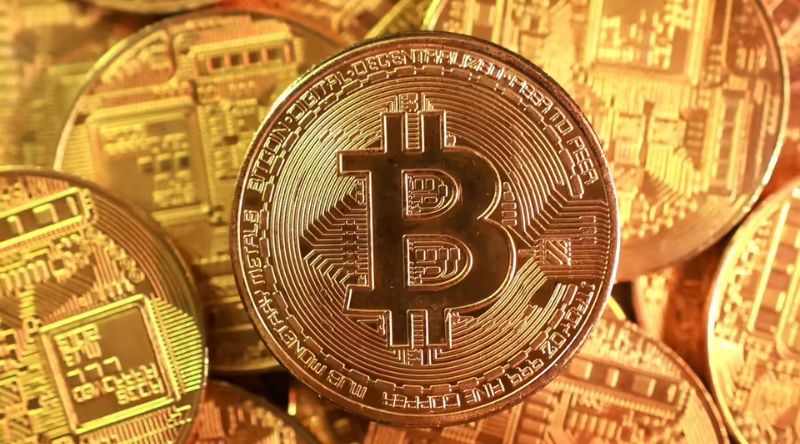
Bitcoin Price Prediction 2026: Can BTC Reach Rs. 1 Crore in India? ETF Demand, Post-Halving Supply, Federal Reserve Policy, Institutional Buying, Technical Indicators, and India’s Crypto Regulations Could Determine Bitcoin’s Next Major Price Move
Overview:
- Sustained institutional inflows into spot Bitcoin ETFs could significantly influence BTC’s price trajectory.
- With only about 2 million BTC left to be mined after the 2024 halving, supply constraints continue to strengthen Bitcoin’s long-term investment case.
- While Bitcoin adoption is growing, India’s 30% tax on crypto gains, 1% TDS, and strict compliance requirements.
Bitcoin’s price has been volatile; it reached record highs at $126,000 in Oct 2025, then pulled back to $65,000 by mid-2026 (around Rs. 60-Rs. 65 lakh). Fed policy and global sentiment have driven recent swings. In mid-2025, Bitcoin rallied on easing Fed expectations and the US’s pro-crypto actions.
Overall crypto market cap exceeded $4.2 trillion by late 2025. Indian investors saw prices translate to record INR levels (Rs. 1.1 Cr at the Oct 2025 peak). At press time, BTC trades at $65,262 with an increase of 0.95% in the last 24 hours.
Demand Drivers
On-chain metrics show subdued retail activity. Active addresses and fee generation continue to trend lower despite the price uptick. However, institutional flows have returned. On July 27, US spot Bitcoin ETFs recorded net inflows for the third consecutive week, the first three-week streak of gains since early May. For the week ending July 24, US-listed spot Bitcoin ETFs recorded a net inflow of $33.79 million. The previous two weeks saw net inflows of $197 million and $75.67 million, respectively.
Data shows that on July 23 and July 24, Bitcoin ETFs recorded net outflows of approximately $225.2 million and $240.1 million, respectively, ending a seven-day consecutive streak of net inflows. BlackRock’s IBIT accounted for the largest outflow, with approximately $415 million withdrawn.
Supply Constraints
Bitcoin’s supply is strictly capped at 21 million. After the April 2024 halving, new issuance was cut in half. Roughly 19 million BTC have now been mined, leaving only 2 million yet to be issued. Halving-driven scarcity and most coins being held long-term mean limited sell pressure.
India Macro & Regulatory Factors
India treats crypto as Virtual Digital Assets (VDAs). Trading on registered exchanges is allowed, but crypto is not legal tender. Gains are taxed at a flat 30% (plus 4% cess) with no loss set-offs, and a 1% TDS on trades over Rs. 10,000/txn. RBI remains cautious (actively developing its CBDC).
Strict KYC/AML (FIU-IND) rules apply. There are no capital gains exemptions: profits under the Rs. 2,50,000 annual LRS limit for foreign investment are still taxable. In sum, heavy taxes and regulation temper Indian demand.
Scenarios
| Scenario | Probability | Expected BTC Price Range (2026) | Key Drivers |
| Bearish | 20% | Rs. 30-50 lakh | Global monetary tightening due to persistent inflation, hawkish US Federal Reserve policy, weaker-than-expected Bitcoin ETF inflows, and stricter cryptocurrency regulations in India. |
| Base Case | 55% | Rs. 60-90 lakh | Steady institutional and ETF demand, gradual capital inflows, reduced Bitcoin supply following the halving, and broadly stable global macroeconomic conditions. |
| Bullish | 25% | Rs. 1-1.5 crore | Strong ETF and retail investor demand, dovish Federal Reserve stance, a weaker US dollar (supporting higher INR Bitcoin prices), greater regulatory clarity in the US and Europe, and wider blockchain and Bitcoin adoption. |
Technical Structure
Bitcoin recovered over 1% last week, marking the fourth consecutive week of gains since the end of June. BTC is holding strong above the 200-week Simple Moving Average (SMA) at $63,561.
If BTC holds breaks and hold sabove 200-day SMA at $63,561 and closes above the immediate resistance at $65,520, then BTC could extend the recovery toward the 61.80% Fibonacci retracement level at $78,490.
The Relative Strength Index (RSI) is trending higher toward the neutral 50 level, with a reading of 43.01. Meanwhile, the Moving Average Convergence Divergence (MACD) flipped to a bullish crossover last week, supporting a positive outlook. However, if BTC fails to find support around $63,561 and closes below it weekly, it could extend the losses toward $59,500.
Also Read: Bitcoin ETF Explained: What Indian Investors Need to Know
Conclusion
Current indicators suggest hitting Rs. 1 crore by late 2026 is unlikely under base-case conditions. A breakout above previous peaks ($125,000) would be needed. As analysts note, a sustained break above $125,000 could propel BTC to $150,000.
FAQs:
1. Can Bitcoin reach Rs. 1 crore in India by 2026?
Yes, but it would likely require a bullish combination of strong institutional demand, continued ETF inflows, favorable global macroeconomic conditions, and Bitcoin reclaiming previous all-time highs above $125,000.
2. What is the most likely Bitcoin price range for 2026?
Based on current market conditions, the base-case scenario projects Bitcoin trading between Rs. 60 lakh and Rs. 90 lakh, supported by steady institutional demand and post-halving supply reduction.
3. How does the Bitcoin halving affect prices?
The Bitcoin halving reduces the number of new Bitcoins entering circulation, creating supply scarcity. Historically, previous halving cycles have been followed by strong price appreciation over the following 12–18 months.
4. Is Bitcoin legal in India?
Bitcoin is legal to buy, sell, and hold in India through compliant exchanges. However, it is not recognized as legal tender, and investors must comply with taxation and KYC regulations.
5. What are the biggest risks to Bitcoin in 2026?
Key risks include tighter global monetary policy, weaker ETF inflows, stricter crypto regulations, geopolitical uncertainty, and increased market volatility that could weigh on investor sentiment.
Disclaimer : Crypto News India does not recommend that any cryptocurrency should be bought, sold, or held by you. Do conduct your own due diligence and consult your financial advisor before making any investment decisions.
