

What RBI’s Anti-Crypto Stance Means for Indian Investors and Exchanges as Central Bank Opposes VDA Legalization, Flags Terror Funding Risks and ICAI Backs Comprehensive Crypto Law
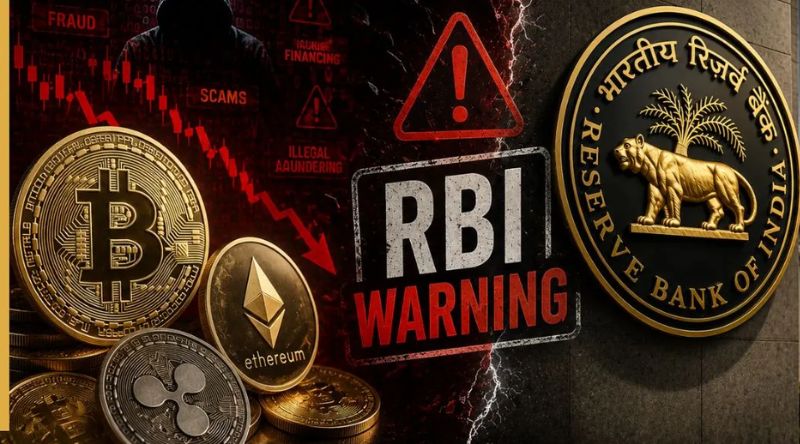
The Reserve Bank of India (RBI) has again taken a firm position against legalising virtual digital assets (VDAs), such as cryptocurrencies, in India. In a meeting with the Parliamentary Standing Committee on Finance, the central bank said the crypto assets are a threat to an emerging economy like India and should not be legalised at this stage.
The committee led by BJP MP Bhartruhari Mahtab held a discussion with the representatives of the RBI on “A Study on Virtual Digital Assets (VDAs) and Way Forward.” The panel also held a meeting with the Institute of Chartered Accountants of India (ICAI) to discuss the regulatory, tax, accounting, and compliance challenges associated with digital assets.
RBI Flags Risks From Crypto Assets
As per PTI, RBI told the parliamentary panel that VDAs could pose threats to monetary stability, enforcement and financial oversight. Digital assets could be used for illegal activities like financing terror and smuggling narcotics, the central bank said.
The RBI also cautioned that offshore crypto firms are difficult to monitor and would create a challenge for the Indian regulators. This is a notable issue for exchanges and investors since several crypto transactions may go to an offshore exchange, wallet, or a decentralized exchange.
According to reports, RBI informed the committee that China and Qatar have not permitted the same financial activities, while Europe has allowed virtual digital currency activities only under strict regulatory measures.
Bhartruhari Mahtab, who was the meeting’s chairman, told reporters after the meeting that the RBI does not support the legalisation of VDA in India. Speaking to ANI, he said, “This meeting was on virtual digital assets. This is the seventh meeting that we are having today. And the RBI had come, and they gave their own view relating to virtual digital assets.”
What It Means for Indian Investors
For Indian crypto investors, RBI’s stance means regulatory uncertainty is likely to continue. Currently, India taxes income from VDAs but does not have a complete regulatory framework for crypto trading, investor protection, exchange operations, or custody protocols.
The tax rate is 30% on crypto gains and 1% TDS on transfers under the framework introduced in 2022. Taxation, however, does not mean legal recognition. There is a continued risk of compliance, access to the exchanges, banking support, and future policy changes for investors.
Impact on Crypto Exchanges
It is a setback for the Indian crypto exchanges as RBI’s position could delay hopes of formal legalisation. Exchanges may face pressure to strengthen the Know-Your-Customer procedures, anti-money laundering controls, reporting requirements, and investor protection measures.
The development also enhances the significance of the central bank digital currency, or digital rupee, in India. Mahtab told ANI, “What India should do is to find a way out. In comparison to other digital assets, RBI’s digital asset is not flourishing as such.”
Also Read: Bitcoin Lending Surges 49% to $67B as Banks Trigger the Biggest Crypto Credit Comeback
ICAI Backs Comprehensive VDA Law
While the RBI had taken an oppositional stance, the ICAI advocated for a comprehensive legislation on VDAs. The institute claims it may provide assistance in the creation of guidance on accounting and auditing of digital assets.
“Accounting and Auditing for VDAs: ICAI can undertake comprehensive research on the various forms of VDAs and analyse their economic characteristics. Based on such research, ICAI may develop detailed guidance on their recognition, measurement, presentation, and disclosure in financial statements,” ICAI said.
FAQs:
1. What did RBI say about cryptocurrencies in India?
RBI told the Parliamentary Standing Committee on Finance that virtual digital assets, including cryptocurrencies, pose risks to an emerging economy like India. The central bank said VDAs should not be legalized at this stage due to concerns around monetary stability, enforcement, and illegal use.
2. Why is the RBI against legalizing crypto?
RBI believes crypto assets can be misused for terror financing, narcotics smuggling, and other unlawful activities. It also flagged the difficulty of tracking offshore crypto platforms, wallets and decentralized transactions.
3. Does crypto taxation mean crypto is legal in India?
No, taxation does not mean full legal recognition. India taxes crypto gains at 30% and applies a 1% TDS on transfers, but it still lacks a comprehensive law for crypto trading, exchanges, custody, and investor protection.
4. What does RBI’s stance mean for Indian crypto exchanges?
Indian crypto exchanges may face more pressure to strengthen KYC, AML controls, transaction reporting and investor safeguards. RBI’s position could also delay hopes of formal legalization or a more supportive regulatory framework.
5. What role can ICAI play in crypto regulation?
ICAI has supported a comprehensive legal framework for VDAs and said it can help develop accounting and auditing guidance. This could improve clarity around recognition, measurement, disclosure and compliance for businesses dealing in digital assets.
Disclaimer : Crypto News India does not recommend that any cryptocurrency should be bought, sold, or held by you. Do conduct your own due diligence and consult your financial advisor before making any investment decisions.
