

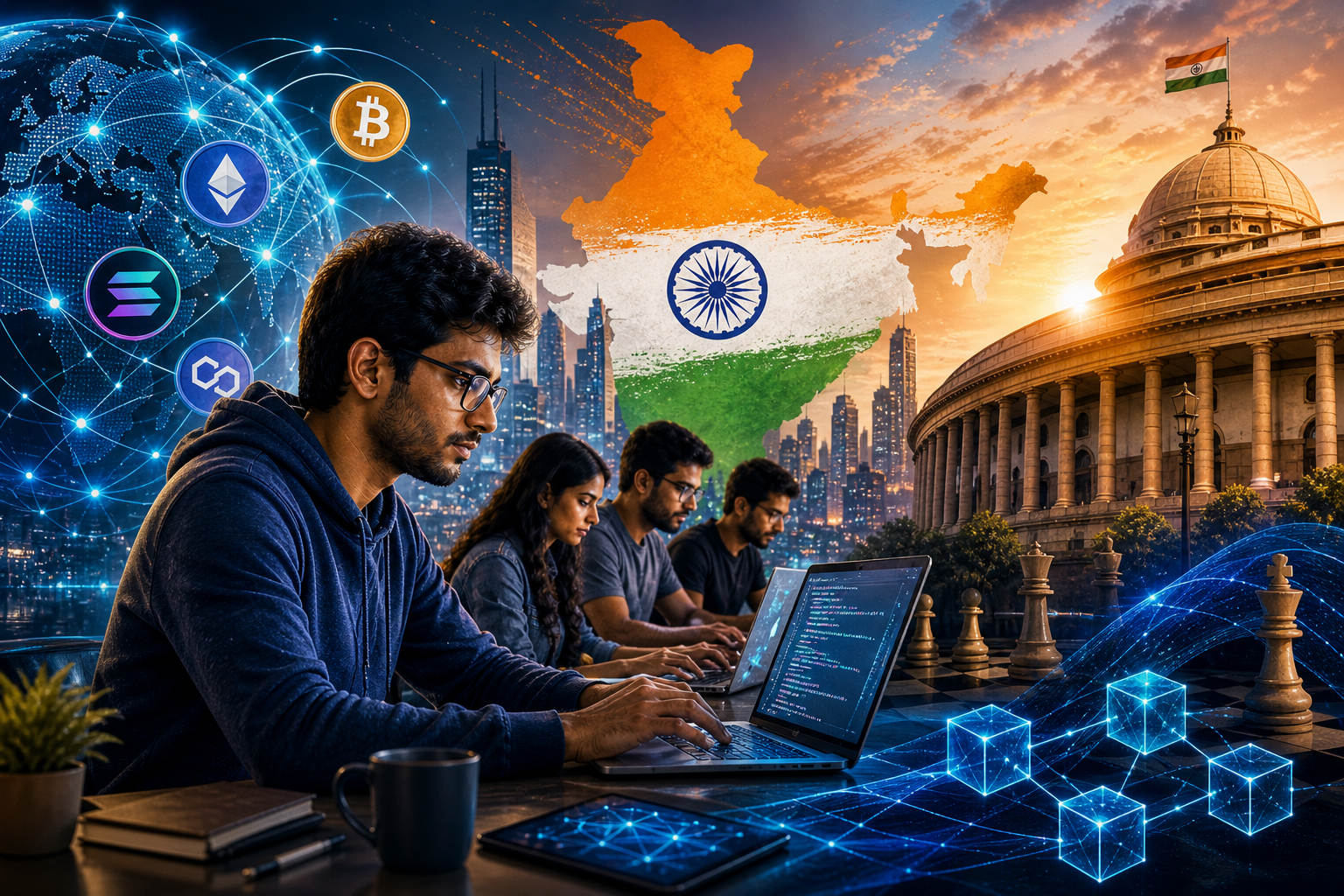
Stablecoins and Open Source: The Quiet Engine Driving India’s Crypto Developer Boom
There is a popular assumption that regulatory uncertainty slows down innovation. In India’s crypto space, that assumption does not hold. While policymakers debate frameworks and tax structures, Indian developers are quietly building some of the most technically ambitious blockchain projects in the world.
Why Regulatory Fog Doesn’t Stop Code From Shipping
The conversation around crypto in India has been dominated by trading volumes, tax burdens and compliance anxieties. The 30% flat tax on virtual digital assets and the 1% TDS introduced in 2022 hammered domestic exchange volumes. But developer activity tells a different story. Code does not wait for legislation.
According to the 2025 State of Crypto report by a16z crypto, global developer activity across blockchain ecosystems has continued to grow through every market downturn. Ethereum’s scaling layers and Solana have both seen sustained builder momentum. Indian developers are part of that momentum contributing to open-source protocols across DeFi lending platforms identity infrastructure and decentralised compute networks.
From Speculative Tokens to Real Infrastructure
What makes blockchain development distinct from most other software work is its borderless structure. A developer in Pune contributing to a DeFi protocol does not need domestic regulatory clarity to ship code. The protocol runs globally from day one. This has allowed Indian builders to remain deeply plugged into international ecosystems without needing to wait for local policy to stabilise.
Stablecoins deserve particular attention here. They have quietly become one of crypto’s most consequential real-world applications. Transaction volumes on stablecoin networks have grown significantly and adoption in cross-border payments and remittances is accelerating. For Indian developers working on global projects stablecoins have also changed how they get paid. Compensation in stablecoins bypasses the friction of traditional cross-border payment rails. No currency conversion delays. No high remittance fees. Instant settlement.
This shift is reshaping how Indian technical talent participates in global markets. A developer contributing to a blockchain protocol in the US or Europe can receive stablecoin payments within minutes. This access to global capital, without geographic or banking friction, is significant for a country with one of the world’s largest developer populations.
The infrastructure being built today also reflects a maturation in the space. Early crypto was dominated by speculative token launches. The current wave involves decentralised identity systems data ownership frameworks and financial infrastructure that could serve billions of unbanked users. These are hard engineering problems and Indian developers are working on them.
Stablecoins Changed How Indian Developers Get Paid
India has the raw ingredients for blockchain leadership. The developer talent pool is large technically strong and increasingly global in orientation. The startup culture is robust. The country’s experience with large-scale digital infrastructure like UPI and Aadhaar shows that India can build financial systems that work at a population scale.
The gap is not talent or ambition. It is the absence of a regulatory environment that allows domestic companies to build confidently raise capital and attract institutional participation. Without that framework Indian-built crypto projects will continue to serve global markets while the domestic ecosystem remains underdeveloped.
The builders are not waiting. The question is whether India’s policy environment will eventually meet them where they already are.
Disclaimer : Crypto News India does not recommend that any cryptocurrency should be bought, sold, or held by you. Do conduct your own due diligence and consult your financial advisor before making any investment decisions.
